
Discover how IT consulting impacts your competitive edge. Learn why prioritizing cybersecurity in consulting is crucial for business success.

November 12, 2026
When cybersecurity is treated as a minor detail in IT consulting projects, businesses quietly lose their edge in winning contracts that require strong security. The real cost often appears long after the project is finished, slowing growth and leaving missed opportunities.
A single overlooked security gap in an IT project can quietly cost a business its next contract, long after the project itself is declared a success.
That's the trouble with treating cybersecurity as a checkbox rather than a priority: the bill arrives late, and it arrives somewhere unexpected. A business that doesn't give cybersecurity its own attention can find itself losing out on contracts that demand strong security, even after the original project wrapped up months earlier. This risk rarely announces itself early, which is exactly what makes it dangerous; it works quietly, slowing growth and handing an edge to competitors who took security seriously from day one.
None of this means IT consulting is just about fixing technical issues or installing new systems. Done well, it builds a foundation that supports business goals and keeps a company ready for whatever comes next. Sideline cybersecurity within that process, though, and the foundation ends up weaker than it looks from the outside.

Many companies hire IT consulting firms to handle everything from software upgrades to cloud migrations, and in projects like these, cybersecurity often slides into the role of secondary task, something to clear quickly so the main work can keep moving.
A few forces push it there. Sometimes the driving goal is finishing on time and on budget, which leaves little room for anything that isn't strictly necessary. Other times the consulting firm itself doesn't carry deep cybersecurity expertise, so the engagement sticks to the basics by default. Either way, the outcome is the same: security becomes a checklist item instead of a core part of the plan.
Once that happens, important details slip through. A consultant might stand up a new system but leave default passwords in place or skip advanced security settings entirely — the kind of gap that's easy to miss in a busy project and easy to exploit once the project is long over.
Small oversights like these compound quietly. A business may notice nothing wrong until a client asks for proof of strong security controls, or until an actual security incident forces the issue. By then, fixing what was skipped costs far more than doing it right the first time would have.
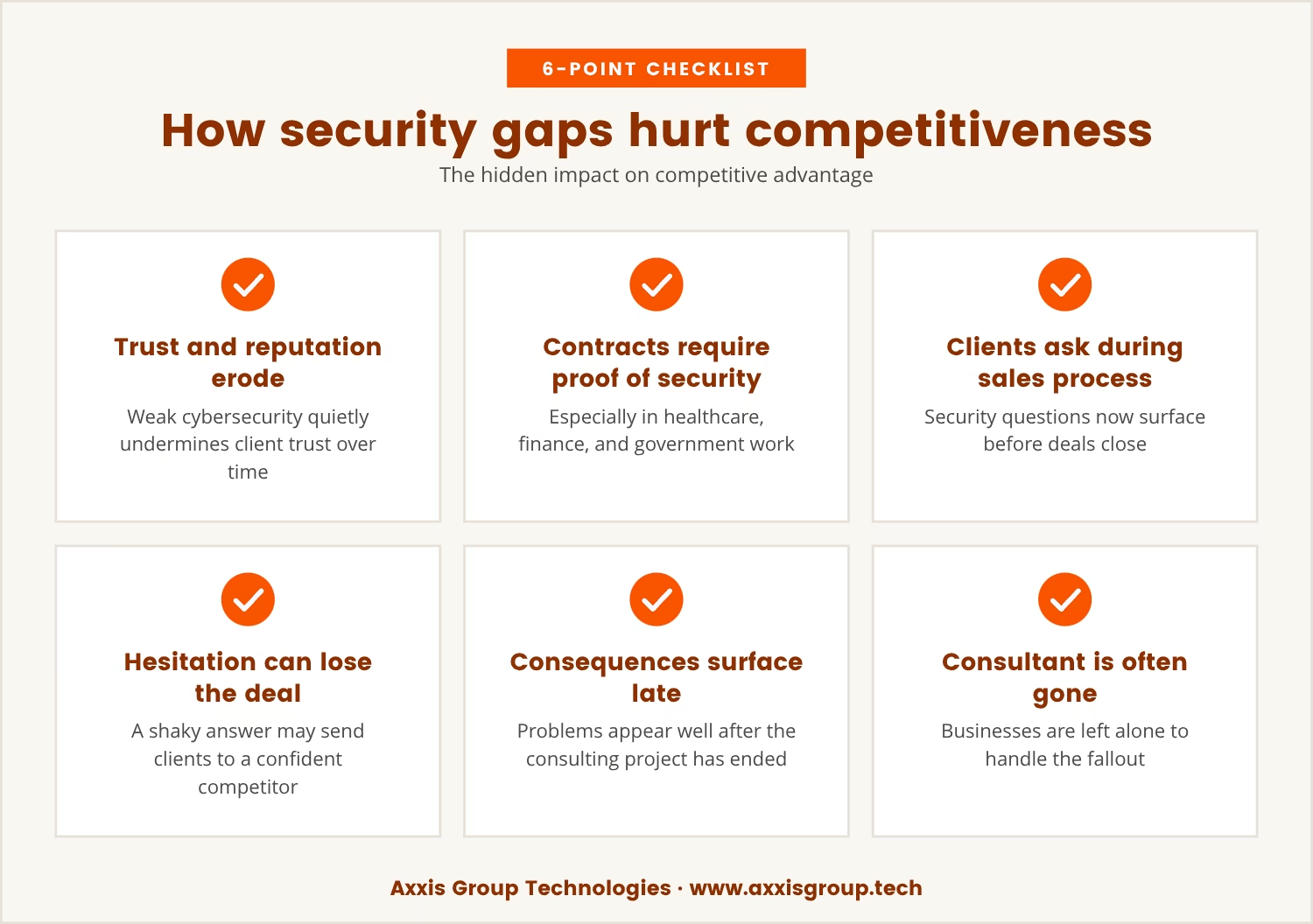
A strong competitive advantage rests on more than technology alone; it depends just as much on trust, reputation, and the ability to meet client requirements, and all three quietly erode when cybersecurity is treated as an afterthought.
Many industries now require proof of strong security before they'll even award a contract. A company that can't demonstrate it meets these standards may get passed over regardless of how good its products or services are — a pattern especially visible in healthcare, finance, or government contracting, where data protection isn't optional but a legal requirement.
Even outside regulated industries, clients are growing more alert to cybersecurity risk and increasingly ask about security practices during the sales process itself. An uncertain answer at that moment can hand the deal straight to a competitor who answers with confidence.
What makes this especially costly is the delay: these consequences tend to surface long after the original IT project has closed out. By the time a business realizes security was never handled properly, the consulting firm is often long gone, leaving the business alone to manage the fallout.
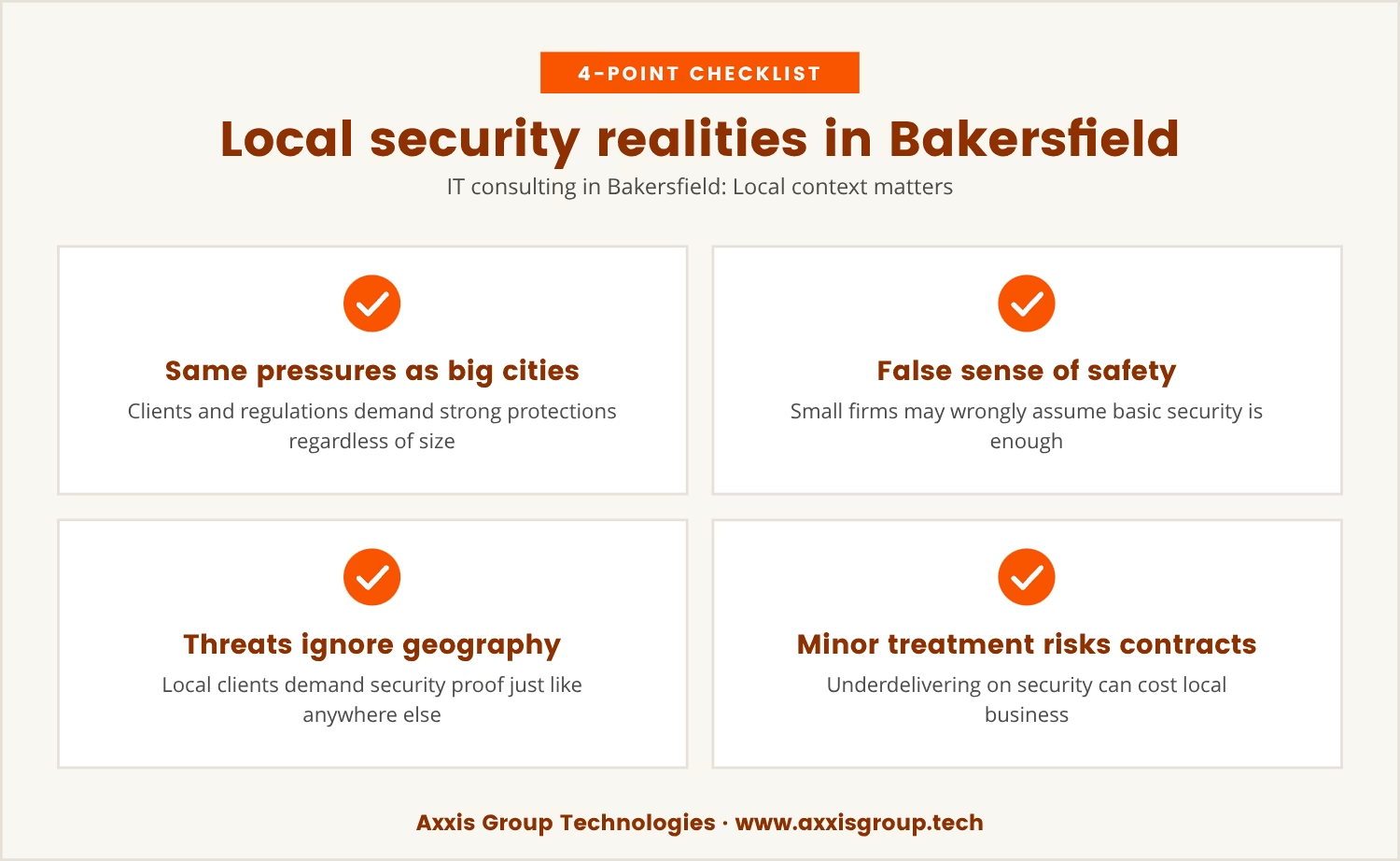
Businesses in Bakersfield face the same pressures as those in larger cities: clients and partners expect strong security, and local regulations may demand specific protections regardless of company size. Yet smaller Bakersfield companies sometimes assume big-city threats don't reach them, or that basic security will cover the gap.
That assumption carries real risk, because cyber threats don't respect geography, and Bakersfield clients are just as likely to demand proof of solid security as clients anywhere else. An IT consulting company that treats security as a minor detail risks losing local contracts that quietly require a higher standard than it delivered.
It's worth asking: has your business ever had to scramble to meet a client's security checklist at the last minute? If so, the root cause may trace back to how cybersecurity was handled during the last consulting engagement.
Skip the integration of cybersecurity into the core IT roadmap, and several problems tend to surface over time rather than all at once. Here are some of the most common ways this quietly erodes a competitive edge:
Consultants focused on project deadlines may skip detailed security planning, and that shortcut can leave gaps in compliance that only surface when a client later asks for proof.
A rushed or surface-level security review can miss hidden vulnerabilities, and those same weaknesses are exactly what attackers look for — or what clients uncover during due diligence.
Treat cybersecurity as a one-time task and there's often no plan left for regular updates or monitoring, which leaves systems increasingly exposed as threats keep evolving.
Without clear records of security measures in place, proving those controls to clients or auditors becomes difficult, which can slow contract approvals or sink them outright.
When security isn't treated as a priority, employees often miss out on the training needed to spot threats or follow safe practices, raising the odds that simple human error triggers a breach.
Should a security incident actually occur, a business that treated cybersecurity as a side task is unlikely to have a clear response plan ready, which only makes recovery slower and more expensive.
Given everything above, the choice of IT consulting partner carries real weight. A consulting firm that treats cybersecurity as a core part of every project helps a business sidestep the hidden costs and risks already described.
Look for partners who open every engagement with a thorough security assessment, and who ask about business outcomes, industry requirements, and future plans rather than just immediate technical needs. That approach builds security into the systems from the ground up instead of bolting it on afterward.
A good partner goes further still, offering clear documentation, regular updates, and training for staff. That support keeps a business ready for client questions about security and backs it up if an incident does occur — the level of support that separates a true partner from a consultant delivering only the basics.
The hidden effects of weak cybersecurity planning aren't always obvious from the inside, so it helps to watch for a few specific warning signs:
If several of these sound familiar, it's worth revisiting how past IT consulting engagements actually handled cybersecurity.
Flip the equation, and treating cybersecurity as a core part of IT consulting pays off well beyond avoided problems: it builds a stronger, more resilient business ready to compete for contracts and grow with confidence.
Clients and partners start to see that reliability directly, recognizing a business that takes security seriously, and that recognition translates into faster, more confident responses to new requirements or threats instead of constant catch-up. Over time, this approach wins more business and protects reputation at the same time.
For companies in Bakersfield and beyond, the lesson holds steady: making cybersecurity a priority in every IT consulting project is an investment in the competitive future.

Many companies with 10 to 150 users only realize the gaps in their security posture when a client demands proof or an incident happens. At Axxis Group Technologies, we understand how easy it is for cybersecurity to become a side task in larger IT projects.
If you want to see how we approach security as a core part of every engagement—or just want to talk through your own setup—let’s start a conversation.
If you qualify, we’ll match your current IT costs or beat them by up to 20%, so you can strengthen your security without overspending.
Ask for clear documentation of the security measures implemented during past projects, since a reliable consulting firm should explain its approach to cybersecurity, provide regular updates, and clarify how systems are protected. Vague answers or struggle to respond are signs that cybersecurity isn't a genuine priority in the work.
Security-first IT consulting better protects a business against threats and makes meeting client requirements far more likely, which in turn helps win contracts, avoid costly incidents, and build trust with partners and customers. It also means less time spent fixing problems after the fact and more time spent on growth.
Cybersecurity consulting can exist as a standalone service, but it should also run through every IT project rather than sit apart from it. Treating it as separate tends to create gaps or missed requirements, so the strongest results come from building security into the overall project plan from the start.
Start by working with consultants who understand the business goals and industry requirements at stake, since that understanding should translate into a roadmap built around regular security assessments, staff training, and ongoing monitoring. This keeps growth plans resting on reliable systems and strong security controls rather than outpacing them.
Choose a partner with proven cybersecurity experience in the relevant industry, clear communication, thorough risk assessments, and a real commitment to ongoing support. Asking for references or case studies showing how they've helped other businesses improve their security posture is a reasonable way to verify all of this.