

Discover how contract clauses in cyber security consulting firms impact risk reduction. Learn what to look for to ensure real protection.

November 5, 2026
Five often-overlooked contract clauses decide whether a cybersecurity consultation actually reduces your risk or just adds paperwork. Most businesses miss these details, leaving them with compliance but not true protection.
A security assessment can run its full course—interviews, scans, a stack of findings—and still leave every vulnerability exactly where it was found, because the contract never obligated anyone to close the gaps it uncovered. That gap between diagnosis and repair is where most of the risk from hiring cybersecurity consulting firms actually lives.
A single clause decides which side of that gap your business lands on: one version of the agreement drives a consultant to reduce your risk; another lets them close the file after checking the right boxes. Many businesses in Bakersfield and beyond sign the second kind without realizing it, because it looks just as thorough on paper.
That's the catch with cybersecurity consulting firms generally: their expertise can identify threats, strengthen defenses, and satisfy regulators, but none of that happens automatically. Unless the contract requires action, not just analysis, you may end up with reports and recommendations and nothing else.
Seeing how these agreements are built, then, matters more than trusting a logo or a sales pitch, since it's the wording—not the reputation—that decides whether your money buys protection or paperwork.

A consulting contract does more than fix a price and a timeline. Buried in its clauses, it also draws the line between what the consultant is on the hook for and what lands back on your desk once they're gone.
A contract built around delivering an assessment hands you a list of risks and stops there, leaving the fixing to you. A contract built around follow-through assigns accountability and measurable outcomes, which is what actually pushes a business toward improvement rather than just awareness of its own problems.
That distinction rarely announces itself—it hides inside technical language or boilerplate templates, which is exactly why so many businesses discover what their contract doesn't cover only after something has already gone wrong. The fix is to read the contract itself as closely as you'd vet the consultant's reputation or service list.
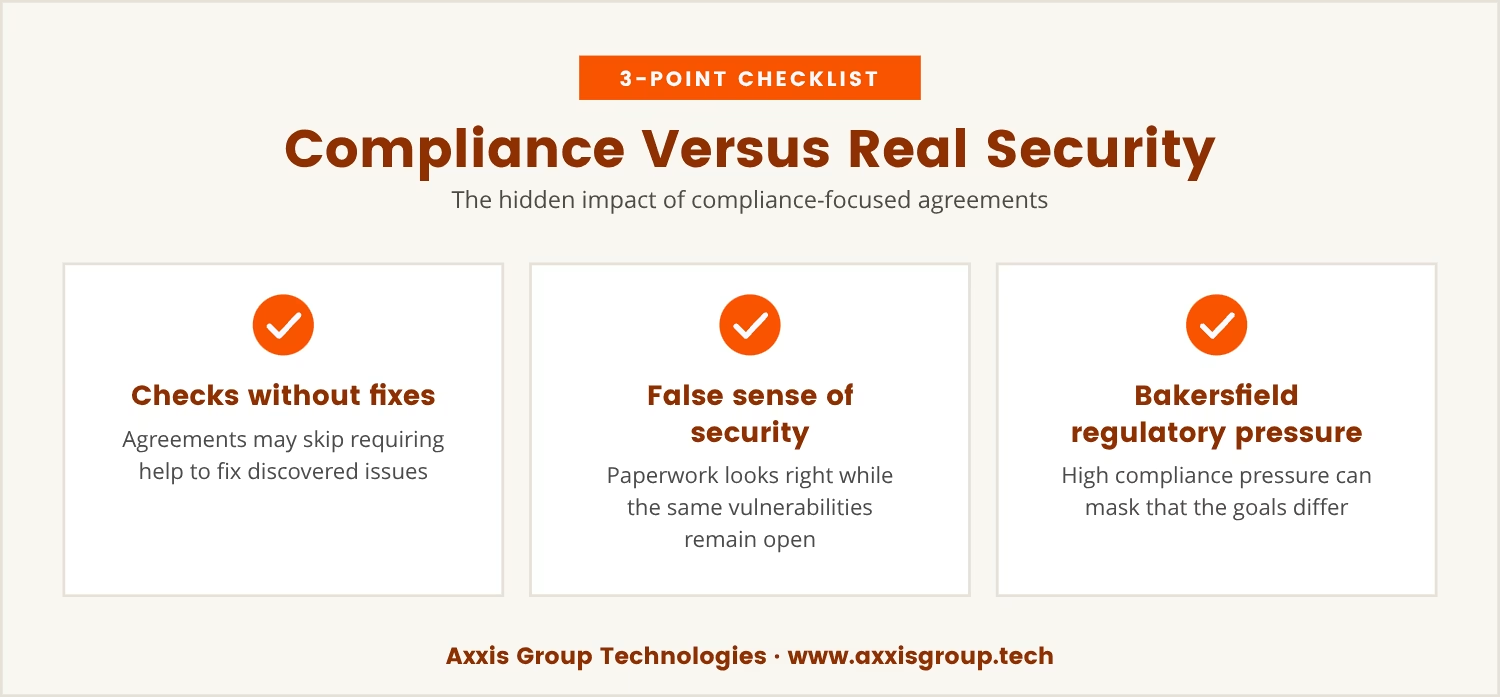
Some contracts exist mainly to get you through an audit. Compliance and security sound like the same goal, but they aren't: one proves you followed a standard, the other proves an attacker can't get in.
A compliance-focused agreement typically commits the consultant to checking policies, running tests, and writing up a report. If it stops short of requiring them to help fix what the report finds, your actual exposure to attack may not shift at all, even though the paperwork says otherwise.
That mismatch breeds a false sense of security: the right binder on the shelf, the same open door in the network. For businesses in Bakersfield, where regulatory pressure runs high, it's easy to let meeting the requirement stand in for the larger goal and miss that the two were never the same thing.
Within contracts from cybersecurity consulting firms, five clauses in particular decide whether the engagement ends in measurable risk reduction or just a longer file cabinet. Each one controls a specific piece of what the consultant does and how much exposure remains once the work is "done."
This clause states plainly whether the consultant fixes what they find or only reports it. When remediation is optional or limited, the hardest problems are the ones most likely to land back on your team.
Some engagements close the moment the final report lands; others build in follow-up meetings and progress checks. Without that second structure, recommendations tend to sit unaddressed long after the invoice is paid.
Concrete targets—fewer vulnerabilities, faster response times—keep a consultant accountable to results rather than activity. Vague promises of an "improved security posture" rarely translate into anything you can verify.
This clause assigns fault if something goes wrong after the engagement ends. Where the consultant's liability is capped low, your business absorbs the cost of any missed risk or incomplete fix.
Sensitive information passes through the consultant's hands during the project, so how it's stored and protected matters independently of how good their technical advice is. A weak clause here can expose you to leaks even when every other recommendation was sound.
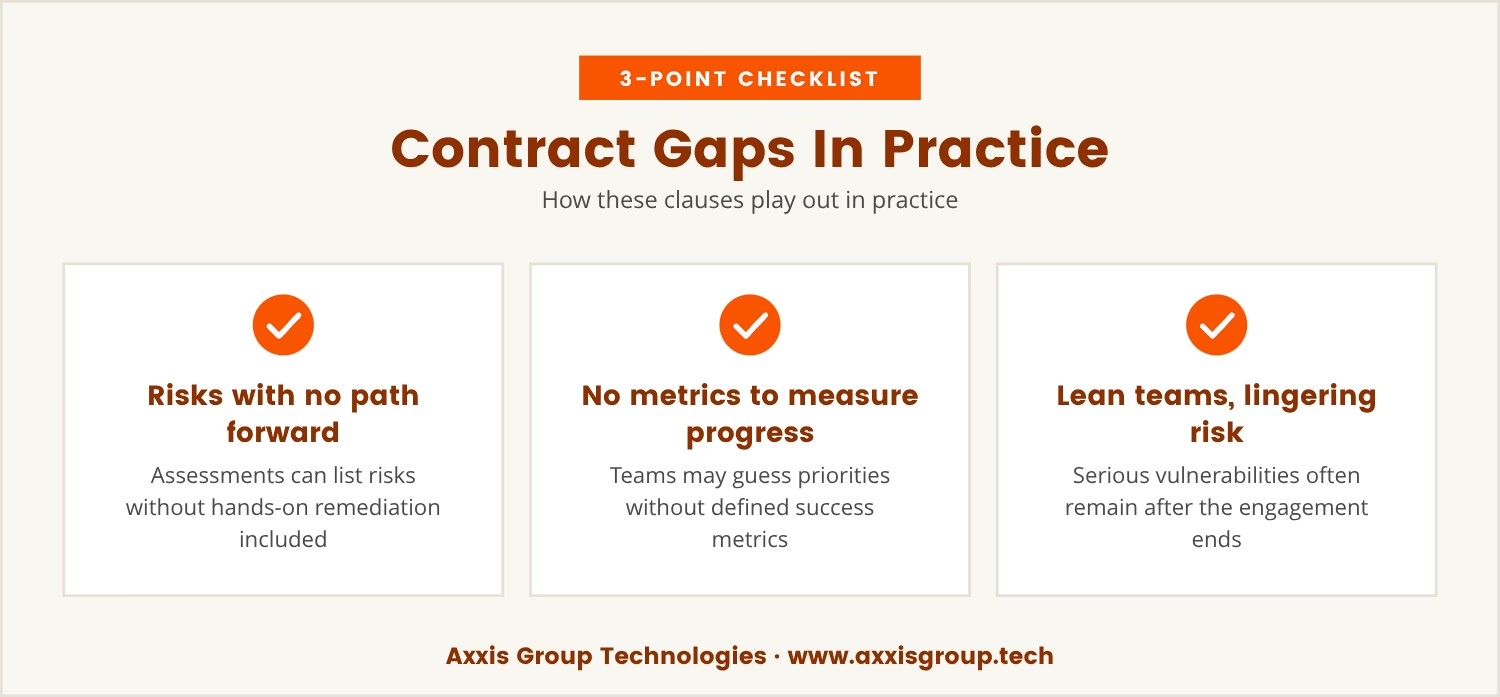
Listed out, these clauses look abstract; in daily operation, their absence shows up fast. A company might walk away from an assessment with a detailed list of risks and no path to acting on it, because the contract never included hands-on remediation.
Or the consultant delivers the findings and moves to the next client, leaving an internal team to guess which issues matter most without the benefit of defined success metrics to measure against—so no one can say with confidence whether the actual risk has dropped.
For Bakersfield businesses running lean IT teams, that gap often means the most serious vulnerabilities are still sitting there after the consultation wraps, unaddressed because nobody was contractually on the hook to address them. The wording decided the outcome long before the engagement started.
A handful of targeted questions, asked before you sign, can surface these gaps while there's still time to fix them:
Each answer narrows the distance between what you assume the contract covers and what it actually says.
For Bakersfield companies, that distance carries real weight. Local regulations and industry standards often push businesses toward outside help, but the quality of that help varies far more than the sales material suggests.
A contract that quietly caps the consultant's responsibilities can leave you exposed even after you've technically satisfied every compliance requirement on the list. A well-structured one, by contrast, turns the same engagement into measurable risk reduction.
So if your own contract is still an open question, start with this: does it require the consultant to fix the problems they find, or only to name them? That single answer shapes your security posture for years past the engagement's end date.
What separates a genuinely secure business from one that merely looks compliant usually traces back to this same contract. Weighing the five clauses above before signing turns a cybersecurity consulting engagement into real risk reduction, rather than another folder of files no one opens again.

Many businesses with 10 to 150 users find themselves unsure if their cybersecurity consulting agreements actually drive real change. At Axxis Group Technologies, we know how easy it is to end up with a contract that looks solid but leaves you at risk.
If you want to see how we approach contract reviews or want to talk through your own setup, we invite you to start a conversation. Let’s make sure your agreement leads to real protection, not just more documents.
We’ll match your current IT costs or beat them by up to 20%—so you can improve your security without paying more than you do now.
Check the contract for a remediation or implementation-support clause. If the language covers only assessments and reports, ask directly for wording that specifies what help follows once risks are identified.
Compliance means satisfying a specific rule or standard; real security means your systems are actually harder to breach or compromise. A consultant can deliver one without the other, since passing an audit doesn't guarantee an attacker stays out.
That depends entirely on what's written into the agreement. Some contracts include follow-up meetings or continued advice, while others close the moment the final report is delivered, so confirm which one you're signing.
Success metrics are specific, measurable targets, such as a reduced vulnerability count or faster incident response times. Without them written into the contract, there's no objective way to confirm whether your risk actually declined.
Look for a strong data handling and confidentiality clause covering storage, access, and what happens to your information once the project ends. Managed service providers often build these protections into their standard contracts.